Subjectivity & the New Aeon
Who we think we are is about to change

Today’s article is about something that, in my experience, pretty much everyone takes for granted - subjectivity, and specifically, our subjective sense of self.
Being a Westerner who, for the last few years, has lived outside the West, and who furthermore is mixed-blood, I have frequently noticed how people where I am now (Istanbul) are subtly different in how they construct a sense of personal selfhood and thus interact with the world. And one of the things I’ve often found rather jarring is the way that Westerners - as representatives of a civilization that has been expanding its global reach through exporting its culture across the globe - either assume that everyone is, deep down, the same as they are, or otherwise ought to be.
Yes, in these days following Joseph Heinrich’s The WEIRDest people in the World, we’re a little bit more cautious about how we express this belief, but nevertheless it endures. But what really is this thing that I’m writing about here? What really is the Western subjective self, and how is it created?
When we are born, I submit, we have no sense of self. We have no sense of being a limited entity; of there being an inside and an outside; of there being anything which specifically is me, or is not me. But, around the ages of one to two, human culture, initially in the form of our parents or other care-givers, comes in and starts to format our mind in a certain manner, not unlike the way those old floppy disks used to in early PCs.
We are given a name. We learn that the lump of flesh we constantly see around is not specifically “us” but it is “our body.” We learn that we “are” inside of a head, and that what we see around us is a “world.” Those explaining these things to us in their various subtle and not-so-subtle ways are “other people” - just like us but different versions. Bit by bit, we learn that we live in a society, that we are members of a wider group of people.
These early teachings that we all receive, no matter where in the world we are born, are the initial commands of the selfhood program that we will from now on run, likely until the day we pass away. They teach us who we are and how we should compose and interact with the world around us in our minds. We will follow this program, not least because, as infants, we are extremely needy. We need to follow the rules to get our needs met.
Now we come to the point where human cultures seem to subtly diverge in how they impress selfhood upon their young. There are perhaps, two groups - Western and non-Western.
Westerners learn to model this self as being an individual - a limited psychological entity, existing inside a head, and experiencing a world outside the head. What gives Westerners their hardened, agentic edge - that which Heinrich picked up on in his book above - is their reliance on thinking and rationality to navigate their world. The worlds of emotions, body language and subtle inference are given less importance in the average Western childhood.
Something I don’t want to do here, in contrast perhaps to some of my phrasing above, is to imply that there is anything “wrong” with Western subjectivity, or the manner in which it is “loaded” into our frontal lobes during infancy. There is not. In many ways, it is an upgrade on how other cultures rear their young - a kind of Self 1.1, if you will. Our capacity to utilize rational thought has undoubtedly granted the West a significant adaptive advantage over other cultures for the last half-millennium.
But, make no mistake, this notion of being an individual who lives inside a head looking out at a world, is not without its issues, especially when the program is allowed to run long-term. Non-Westerners encountering Westerners are frequently bemused at just how guilt-ridden so many of them appear to be - forever hand-wringing over past atrocities they believe they have committed and desperate to somehow make amends. This behaviour leaves non-Westerners at a loss. They simply have no clue what’s going on. Live in the MENA region (Middle East North Africa) for a while and you will often encounter Americans hysterically apologizing to English-speaking locals, in social situations, for the terrible behaviour of their leaders - Bush, Trump, whoever. To the locals, if you do something bad, you either harden and continue along, or you soften and cry about it. You don’t spend the rest of your days wracked with guilt. Why do that?
BTW, if you’d like to observe this phenomenon happening in real time, check out this YouTube video of Arab-American academic Musa Al-Gharbi - author of another excellent piece of Westerner observation We Have Never Been Woke - being questioned by an elderly Jewish American lady, who, clearly experiencing guilt overload, cries out repeatedly “What would you have us do?”
The immense levels of guilt that this lady, along with many millions of other thinking Westerners constantly suffer from, come in I think, because there is actually no “I” living inside our head. It’s the useful artifact of the thinking behaviours that our culture has had us develop - a centre of narrative gravity - as philosopher Daniel Dennett has described it. And because it doesn’t exist, and because it blocks access to deep feelings through its learned need to perform, it easily gets overloaded with emotion and simply can’t handle feelings beyond a certain low level. All it can do is to try and think its way through and thus goes round and round.
But perhaps it soon won’t need to.
For it seems that the very sense of self that has given Westerners our adaptive advantage - that has enabled us to develop the tech and modern systems that have undoubtedly transformed the globe - is actually now out-of-date and arguably being deprecated in the face of an agentic machine intelligence that can increasingly outperform it. Like that old movie Invasion of the Bodysnatchers, we Westerners seem to have created something that will replace us, or at least render obsolete our old way of thinking about who we are.
So who will we become? Being plunged into an existential crisis by our own creation forces the brave souls among us to deeply introspect on who we really are, underneath all the thinking and doing. And to then try to plot a new path out from that place. I think such a search inevitably turns mystical pretty quickly. I myself am busy with this question. And this is where this written piece will get more speculative and perhaps a little “out there.”
I would like to ask - are we actually in the grip of an “aeon changeover?”
Since the days of Plato, people have been taken with the notion that, every 2100 years or so, the aeon shifts back one in the wheel of the twelve astrological houses. Meaning that, around this time, we will go from Pisces, where we’ve been since the birth of Christ, back to Aquarius.
Here’s an image that has long intrigued me.
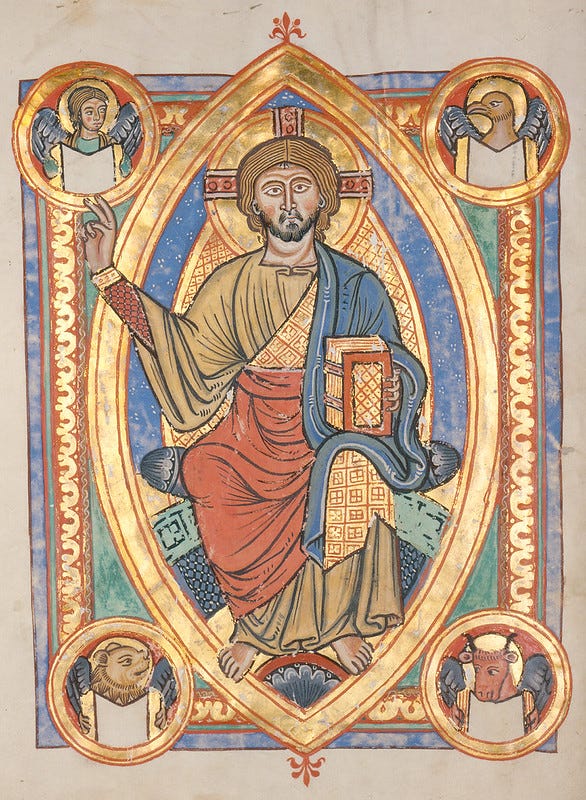
This piece of medieval iconography was one of the most dominant and defining artistic motifs of the European Middle Ages. It features the figure of Christ seated inside a geometric shape - one formed by two intersecting circles and known as a Vesica Piscis.
The figure of Christ has provided an idealized image of self for countless generations of Christians over much of the last 2,000 years. We form an image of self as being an individual living inside a head, and we aspire to be like Jesus. He provides a moral template for this kind of subjective self. And, at times, such as during the Protestant Reformation, this sense of self and its idealized image have been slightly updated.
The connection to the astrological house of Pisces is self-evident here. But what of the Vesica? What’s that about? A vesica is a protective membrane. You use it to keep something safe; safe from anything which might ingress upon it from the outside.
So what might this image be trying to tell us about Christianity, subjectivity and the Piscean Era?
What I believe it says is that the Western way of formulating selfhood, itself deeply entangled with Christianity, provides a temporary vessel to keep our body and bodily energy safe from negative influences for the term of the Piscean Era. And that thus, after this time, there will be a shift. Indeed, the only bit of Christ which penetrates the Vesica is his right hand, which points upright in the gesture associated with intuitive listening, toward a smaller icon representing Aquarius, in the top left of the picture.
So Christianity, and the culture that developed around it, was not intended to formulate Western subjectivity in perpetuity. Rather it has provided a means of keeping our body, and what it contains, safe throughout a time of what would presumably otherwise be peril. During the same period, this manner of creating selfhood has led to the development of the tech that will forge the next era, that of Aquarius. Christ’s hand thus points to Aquarius for it is the intuitive guidance from that time that has informed this era.
You may have noticed, as I bring this article to a close, that I have not explained how I see Aquarian Era subjectivity as being. If we will no longer be individual experiencers of a life going on outside of us from inside a head - how will we be? Neither have I explained why I think “the body and its energy” is so important. I have some ideas here but I will wait for a further piece to better tackle them, when hopefully my own intuitive faculties have provided me with more solid insights.
Thank you, as ever, for reading my work. I also have a new YouTube channel, sharing my esoteric and mystical endeavours. You can find it here.
What about consumption? I would argue that for a lot of people now thinking has largely been suspended and life largely consists of work and media consumption, online shopping etc etc
If AI negates the need for thinking would this not just push people into hyper-consumption as opposed to body awareness? Even less time thinking and even more time consuming
Especially because embodiment is incredibly dangerous to the capitalists, the Zionists and all manner of elite class demons - it shrinks our petty (ideological) grievances with each other and creates human unity - and we all know the thing the elites fear the most is human unity
Curious as to your thoughts
Enjoyed reading that. Thanks Dev. One point, I'm not sure all Westerners feel guilt. Seems to the thing that cleaves our politics though.